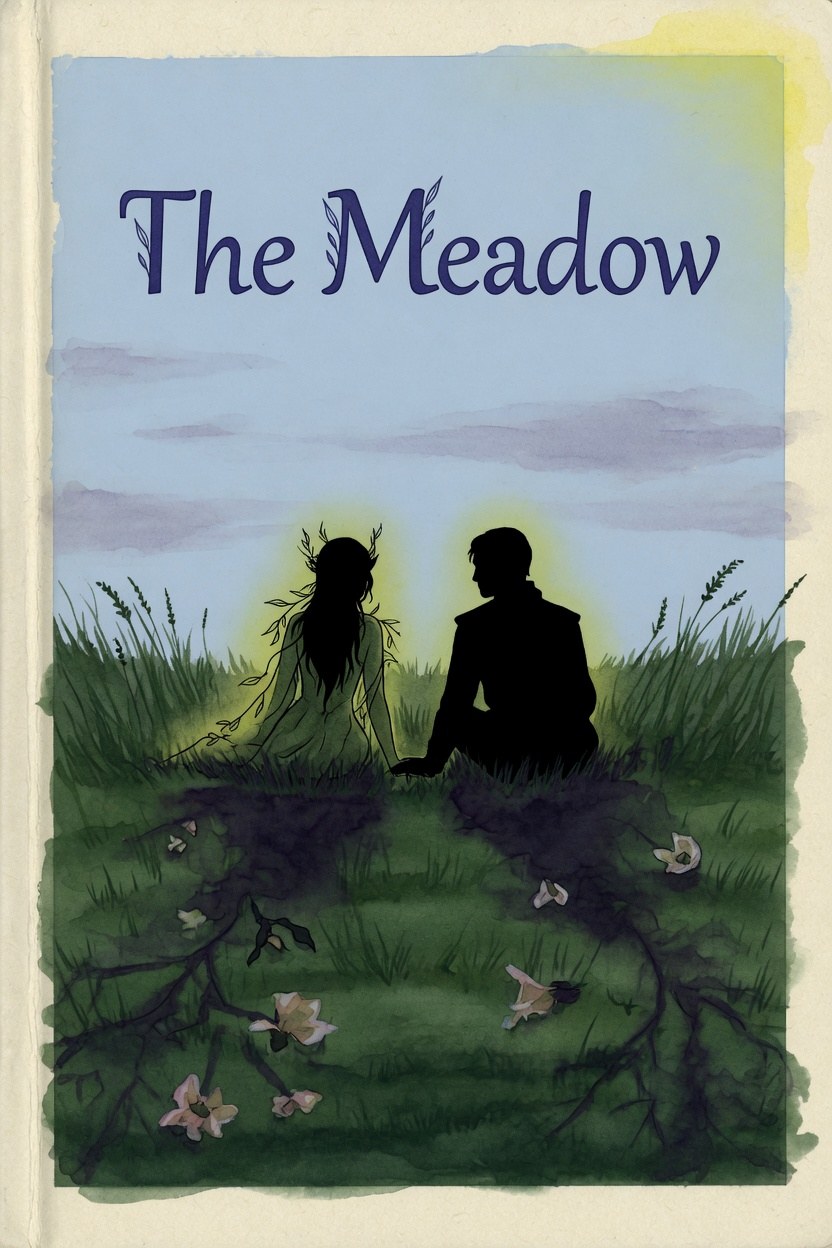
The meadow was still naming itself when Ffion knelt. Dawn had thinned the air along the hedge, and she came through where the gap always opened, her fingers smelling of last night's foxglove. She carried a curved blade no wider than her thumb, tin-bright, and she moved among the wet blooms with the patience of someone who knew exactly which ones the morning would forgive.
She chose yellow first. The little heads bowed under their own dew, and she cut them low, just above the second leaf, sliding each stem into the basket she had woven from last winter's rushes. The grass was dark with water, and her knees soaked through before she noticed. She never hurried here. The veil smelled like rain on stone and something older, like a hearth gone cold in a house no one could find.
She was reaching for a bloom that had not yet opened when the hedge shivered.
A man came through the gap with a long-handled hook in one hand and a leather bag over his shoulder. He was broad across the shoulders, sun-brown on the arms, dust-colored from the knees down where the path had powdered his trousers. He walked the way men walked who knew exactly how far they had come and how much further they had to go. He stopped when he saw her, and his mouth opened as if he had forgotten the word he meant to say.
"God above," he said, and then, quieter, "I thought you were a hare."
She did not answer. The blade rested against her knuckle, and a bead of dew slid down it onto her wrist.
"I'm Bram," he said. "From the mill. I cut the verge for Widow Hay each spring, before the bramble takes it." He set the hook against a stump and crouched, the way men do when they mean to make themselves smaller for a woman's sake. "You're early for a gleaner."
Ffion tilted the bloom she had cut so the water ran off into the grass. She had heard the mill before, the low complaint of it carried on the wind at dusk, but she had never heard it walk.
"Are you hungry?" he asked, and before she could decide, he was already in his bag, bringing out a heel of bread wrapped in cloth and a small leather flask. "It's only oat. The water's from the brook, not the wheel-race."
She watched him set the bread on a flat stone between them. The cloth was checked, blue and white, and the loaf was still warm. He must have baked it before first light and carried it against his chest to keep it so. The thought of that warmth traveled through her in a way she did not name.
"I will not give you my name," she said.
He blinked. "I didn't ask."
"I know," she said. "I am telling you this now, so the question will not have to be asked."
He looked at her a long moment, and something in his face shifted from surprise into a kind of carefulness, as if he had noticed, for the first time in his life, the weight of a word held back. He pushed the bread a little closer to her on the stone.
"Take it or don't," he said. "But I've walked four miles with it under my shirt, and it will only go to the ants."
She reached out and took it. The crust cracked under her fingers, and the smell of it rose, yeast and salt and a sweetness she had no word for. She did not look at him while she broke off the first piece, and he did not speak while she ate. The brook ran somewhere behind the hedge, and a bird she did not recognize sang three notes and stopped.
He drank from the flask and offered it to her. She took it, and the water tasted of the stone it had lain against, and of his mouth on the rim, and she wiped the rim with her thumb before she gave it back, because she had not yet decided how much of him she meant to carry.
"The yellow ones," he said, nodding at her basket. "Are they for the Widow too?"
"They are for me," she said. "They open first. They are easiest to hear."
He nodded as if this made sense. "Will you be here at dusk?" he said. "I can bring supper. I have a sister who would half-kill me for saying so, but she keeps a good pot."
Ffion looked at the bread in her hand. The piece she had not yet eaten sat in her palm like a small warm animal, and she felt it settle into her, somewhere below the throat, below the sternum, into that part of her that knew the difference between a thing given and a thing taken. The veil thinned a breath more along the hedge, as if it had tasted the bread with her.
"I will be here," she said.
He stood, and his joints gave a small sound, the way joints do in men who have worked since they were boys. He shouldered his hook, nodded once, and went back along the verge, parting the bramble with his forearm. She watched the gap close behind him, the hedge stitching itself shut like a mouth.
Alone again, she ate the rest of the bread slowly. The meadow listened. Somewhere, a lark went up and hung. The dawn warmed against her back, and the yellow blooms in her basket lifted their heads as if they had been waiting for permission.